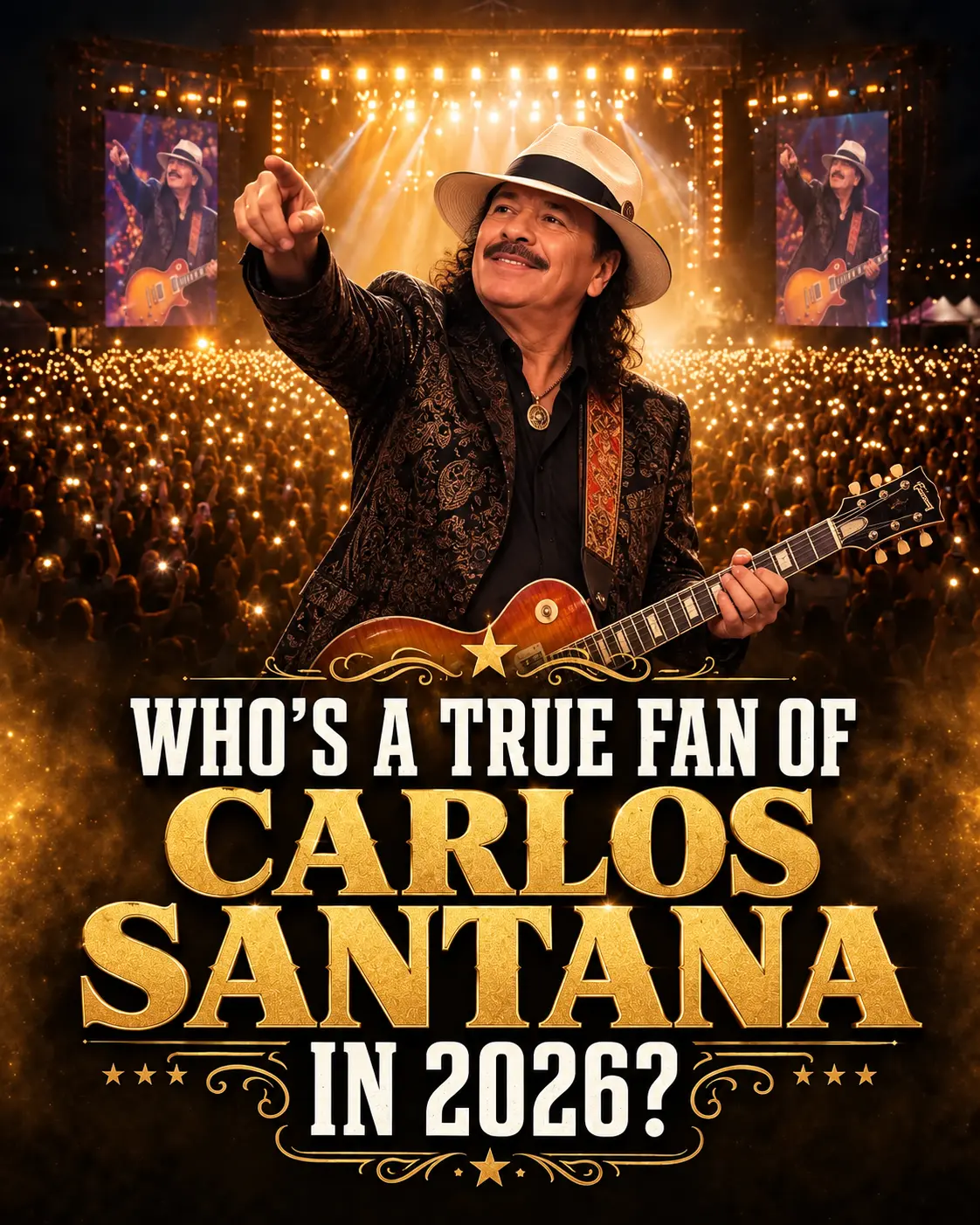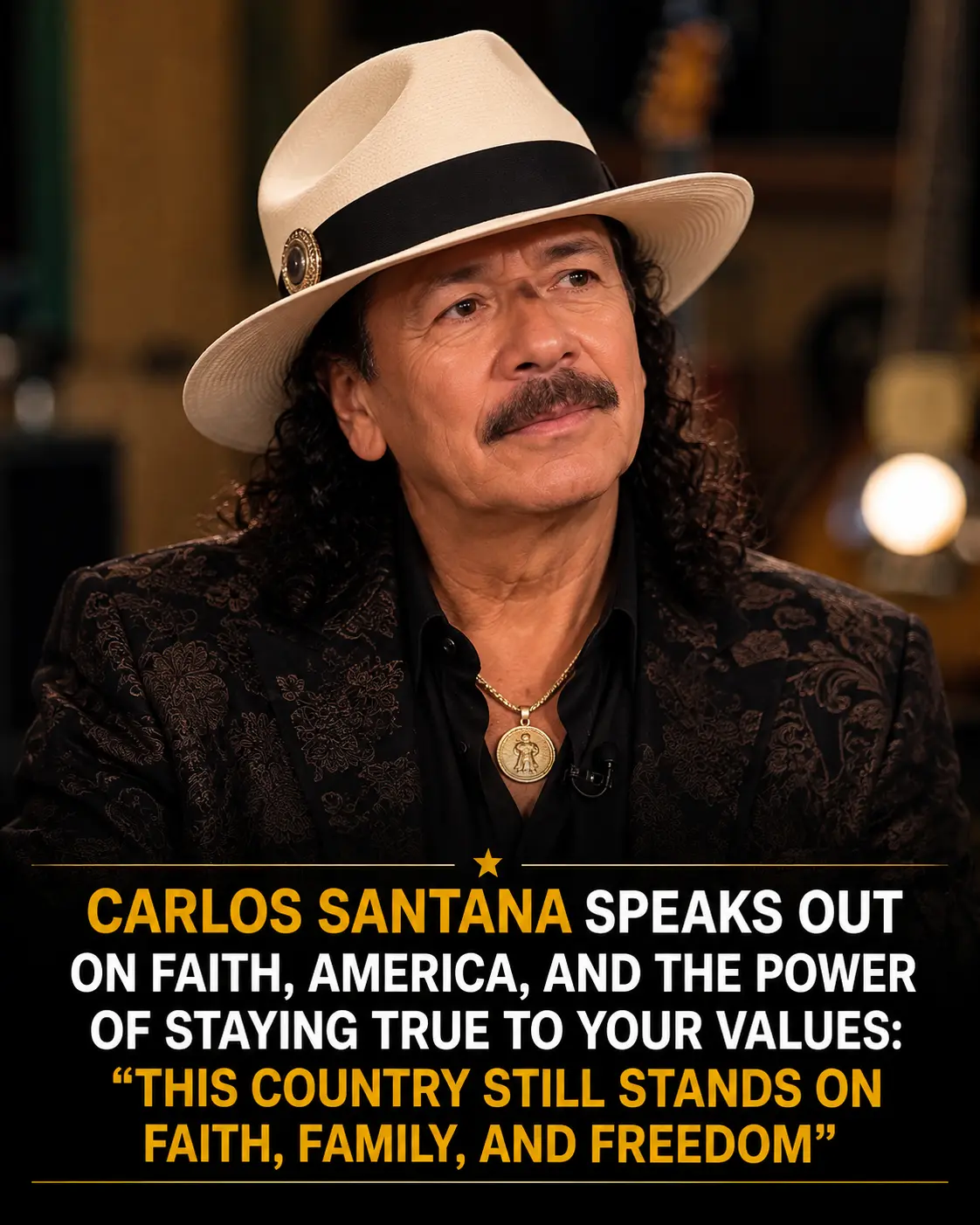
🎸🇺🇸 “AMERICA DOESN’T NEED MORE DIVISION — IT NEEDS MORE HUMANITY…” — Carlos Santana’s Message of Unity, Responsibility and Hope Reignites a Powerful Conversation About What Music Can Still Mean in a Divided Country
Carlos Santana has spent most of his life communicating without needing many words.
One guitar note can be enough.
For decades, his unmistakable sound has crossed boundaries of nationality, generation, language and musical genre. Rock audiences embraced him. Latin audiences recognized something familiar in his rhythms. Blues listeners heard the emotion. Younger generations discovered him all over again through collaborations that brought his guitar back to the center of popular culture.
But Santana has rarely treated music as entertainment alone.
Running alongside the guitar has been another consistent theme: his belief in unity.
Peace.
Compassion.
Personal responsibility.
Human dignity.
And the idea that people have far more connecting them than separating them.
That philosophy has sometimes taken Santana beyond music and into broader conversations about society, spirituality, humanitarian responsibility and America's future.
Now, as public debate grows increasingly polarized, that worldview has renewed resonance.
For supporters, Santana represents an artist willing to use his enormous platform to encourage people to look beyond division.
For critics, the larger question remains familiar: How far should entertainers step beyond the stage and into debates about the direction of society?
Santana's own career suggests he has never accepted a strict boundary between the two.

To understand why, it helps to return to the beginning.
Santana was born in Mexico before moving to the United States as a teenager.
His musical identity developed in San Francisco during one of the most culturally turbulent periods in modern American history.
The late 1960s were filled with conflict.
Civil-rights struggles.
The Vietnam War.
Generational rebellion.
Political upheaval.
At the same time, musicians were experimenting with the idea that art could challenge cultural boundaries.
Santana emerged directly from that environment.
Then Woodstock changed everything.
When Santana performed at the festival in 1969, the band was still unfamiliar to much of America.
That did not last long.
Their explosive combination of rock, blues, Latin percussion and improvisation created something audiences could recognize emotionally even if they had never heard anything quite like it.
In later reflections on Woodstock, Santana has described its meaning through ideas of coexistence, unity and harmony.
Those ideas did not disappear when the festival ended.
They became recurring themes throughout his life.
That matters because Santana's message today cannot be separated from the musician he has always been.

His guitar itself is evidence of cultural fusion.
Santana never built his musical identity by insisting that one tradition had to defeat another.
He combined them.
Latin rhythm could exist beside American blues.
Rock could coexist with jazz.
Percussion could interact with electric guitar.
Musicians from different backgrounds could meet inside one composition and create something that none could have produced individually.
In that sense, Santana's music has always demonstrated his philosophy before he ever explained it.
Different does not have to mean divided.
Difference can create harmony.
That principle eventually extended into humanitarian work as well.
Santana and his family established the Milagro Foundation in 1998, focusing support on underserved children and young people through education, health and the arts.
His history of philanthropy has included support for causes reaching far beyond the music industry.
That record is important because it demonstrates that Santana's language about compassion has not existed exclusively in interviews.
He has repeatedly connected his success to the responsibility to give something back.
And responsibility is one of the themes at the center of the broader conversation now surrounding him.
America's problems are enormous.
No guitarist can solve them.
No celebrity speech can eliminate political division.
No concert can permanently erase disagreements between millions of people.
Santana has never needed to possess a legislative solution to every national problem for his central idea to remain worth discussing.
His message is more basic.
What happens if people begin with dignity rather than hostility?
What happens if disagreement does not automatically become hatred?
What happens if personal responsibility matters alongside demands placed on institutions?
What happens if Americans stop treating every cultural difference as evidence that they belong to opposing tribes?
Those questions reach beyond party politics.
They reach into families.
Schools.
Neighborhoods.
Workplaces.
Social media.
Even entertainment.
Santana has spoken for years about “oneness,” a spiritual concept central to his worldview.
For him, unity does not necessarily mean everyone thinking identically.
A Santana song itself would contradict that idea.
Different instruments have different roles.
The drums do not need to become the guitar.
The bass does not need to imitate the organ.
Harmony exists because different sounds learn how to occupy the same musical space.
It is an appealing metaphor for a country defined by enormous cultural diversity.
But it is also where debate begins.
Some listeners welcome musicians speaking about society.
They argue that artists are citizens too.
They pay taxes.
Raise families.
Vote.
Experience discrimination.
Support charities.
Watch national events unfold.
Why should fame remove their right to participate?
Others are uncomfortable when entertainment and social commentary mix.
They buy a ticket to hear “Black Magic Woman” or “Oye Como Va,” not to receive a lecture.
That tension is hardly unique to Santana.
Musicians have participated in public debates for generations.
Folk singers.
Rock stars.
Country artists.
Rappers.
Jazz musicians.

The argument over whether they “should” speak is nearly as old as celebrity culture itself.
Santana's answer has generally been found in his actions.
He keeps speaking about peace.
He keeps talking about compassion.
He keeps supporting humanitarian causes.
And he keeps returning to music as the language capable of reaching people when ordinary conversation fails.
There is something significant about that approach.
Political discourse often demands that people choose sides before they even begin listening.
Music works differently.
A guitar does not ask which party someone supports before reaching them.
A melody does not inspect a passport.
Rhythm does not require agreement.
Twelve thousand people inside an arena can disagree about almost everything outside the building and still sing along to the same song.
For several minutes, they become one audience.
Santana appears fascinated by that possibility.
It may explain why words such as “unity,” “harmony,” “oneness,” “light,” “hope” and “peace” repeatedly appear when he discusses the purpose behind his work.
To some listeners, that language can sound idealistic.
Perhaps it is.
But Santana came from a generation whose musical culture openly experimented with idealism.
Woodstock itself became symbolic partly because people wanted to believe another way of relating to one another was possible.
Decades later, Santana has not completely surrendered that belief.
That persistence may be more remarkable than the message itself.
Cynicism is easy.
Division generates attention.
Anger travels quickly online.
Algorithms reward conflict because conflict keeps people watching.
Reconciliation is less dramatic.
Compassion rarely becomes a viral shouting match.
But Santana's worldview suggests that those quieter values still matter.
His philanthropy reinforces another component: ideas mean more when accompanied by action.
Unity cannot exist solely as a slogan.
Compassion requires behavior.
Concern for children means supporting education, health and opportunity.
Concern for communities means participating rather than merely complaining.
Personal responsibility means asking not only what others should change, but what each individual can contribute.
That is where Santana's public philosophy becomes more interesting than a celebrity soundbite.
His career offers an example of someone who benefited enormously from America's cultural possibilities while maintaining a strong connection to his Mexican roots.
He did not have to erase one identity to participate in another.
Instead, he built a musical language from both.
That experience inevitably shapes the way he talks about America.
A country can contain multiple cultures without losing its identity.
A band can contain multiple sounds without becoming noise.
But both require listening.
That may ultimately be the simplest interpretation of Santana's message.
Listen.
Not merely wait for your turn to respond.
Not immediately classify the person speaking as an ally or enemy.
Actually listen.
It sounds almost embarrassingly simple.
Then again, some of Santana's most powerful musical moments are built around simple ideas.
One sustained guitar note.
One rhythm.
One melody repeated until thousands recognize it.
Maybe societies are more complicated.
They certainly cannot be repaired with a guitar solo.
But music can demonstrate something political arguments frequently forget:
Human beings are capable of sharing space without becoming identical.
Carlos Santana has spent decades proving that musically.
Whether listeners agree with every statement he makes outside music is another matter entirely.
That decision belongs to them.
But the conversation surrounding his message reflects something real about the current moment.
People are searching for ways to talk about national identity without immediately falling into hostility.
They are debating the responsibilities of public figures.
They are questioning whether unity remains possible when disagreement is everywhere.
Santana does not provide a complete answer.
Perhaps no artist could.
Instead, he offers the philosophy that has followed him from the counterculture of San Francisco to Woodstock, global superstardom and decades of humanitarian work.
Unity.
Harmony.
Responsibility.
Hope.
And the belief that difference does not automatically have to become division.
Maybe that sounds idealistic.
But Carlos Santana has built an entire musical legacy by taking sounds that seemed different and proving they could belong together.
Perhaps that is precisely why people are still listening.
🎤 CARLOS SANTANA HAS ALWAYS BEEN MORE THAN A ROCK GUITAR LEGEND.
For decades, his music and humanitarian work have carried themes of unity, compassion, spirituality, peace, and responsibility toward others. Now, Santana’s enduring message about bringing people together — and what individuals can do to create a more hopeful future — is once again sparking passionate conversation across America.
Some listeners applaud his willingness to speak beyond music. Others continue to question whether artists should step into conversations about society and the direction of the country. Either way, Santana has never treated music as something completely separate from the world around him.
What exactly does unity mean to an artist whose career was built by bringing different cultures, rhythms, and generations together? Why does his message resonate so strongly with some people while challenging others? And how does it connect to the values that have shaped his extraordinary journey from Mexico and San Francisco to Woodstock and stages around the world?
👉 Read the full story here and discover why Carlos Santana’s message of unity, compassion, and personal responsibility continues to inspire conversation: [LINK]
💬 Full details in the first comment below. 👇