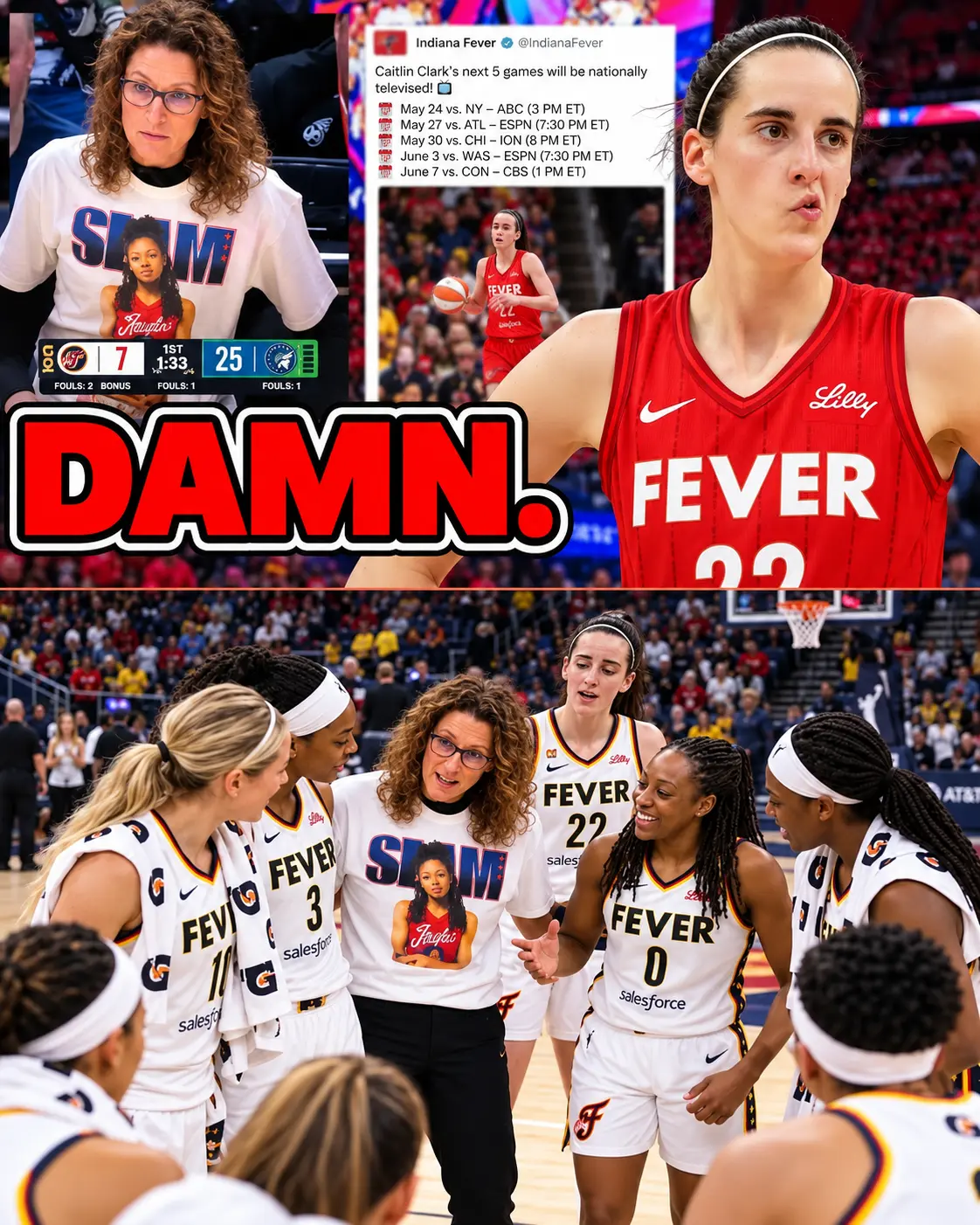
🚨🏀 “IT WAS JUST A SHIRT — UNTIL FANS STARTED READING BETWEEN THE LINES…” — Stephanie White’s Kelsey Mitchell Tribute Ignites a Fever Firestorm as One Sideline Gesture Fuels Questions About Indiana’s Locker-Room Hierarchy 🔥
Sometimes the biggest basketball debates begin without a basketball being touched.
No controversial whistle.
No technical foul.
No heated press conference.
No dramatic fourth-quarter collapse.
Just a shirt.
That was enough to send Indiana Fever fans into detective mode after head coach Stephanie White appeared wearing clothing prominently celebrating Kelsey Mitchell.
On the surface, the gesture appeared simple.
A coach supporting one of her players.
Nothing more.
But this is the Indiana Fever, one of the most intensely scrutinized teams in women's basketball, and almost nothing surrounding the organization remains simple for long.
Within hours, images of White's shirt were being dissected across social media.
Some fans loved it.
Others immediately began asking questions.
Why Mitchell?
Why now?
Was White simply showing appreciation for one of Indiana's most important veterans?
Or was the wardrobe choice intended to communicate something larger about leadership, recognition and the internal structure of a roster dominated publicly by conversation surrounding Caitlin Clark?
The speculation quickly became much bigger than the shirt itself.
To understand why such a small gesture could generate such an outsized reaction, consider the environment surrounding Indiana.
Clark attracts enormous attention.
Every performance is analyzed.
Every interaction becomes a clip.
Every quote can become a headline.
Every photograph is capable of generating thousands of comments.
That attention has transformed the Fever into one of the most visible teams in women's basketball.
But Indiana is not a one-player operation.
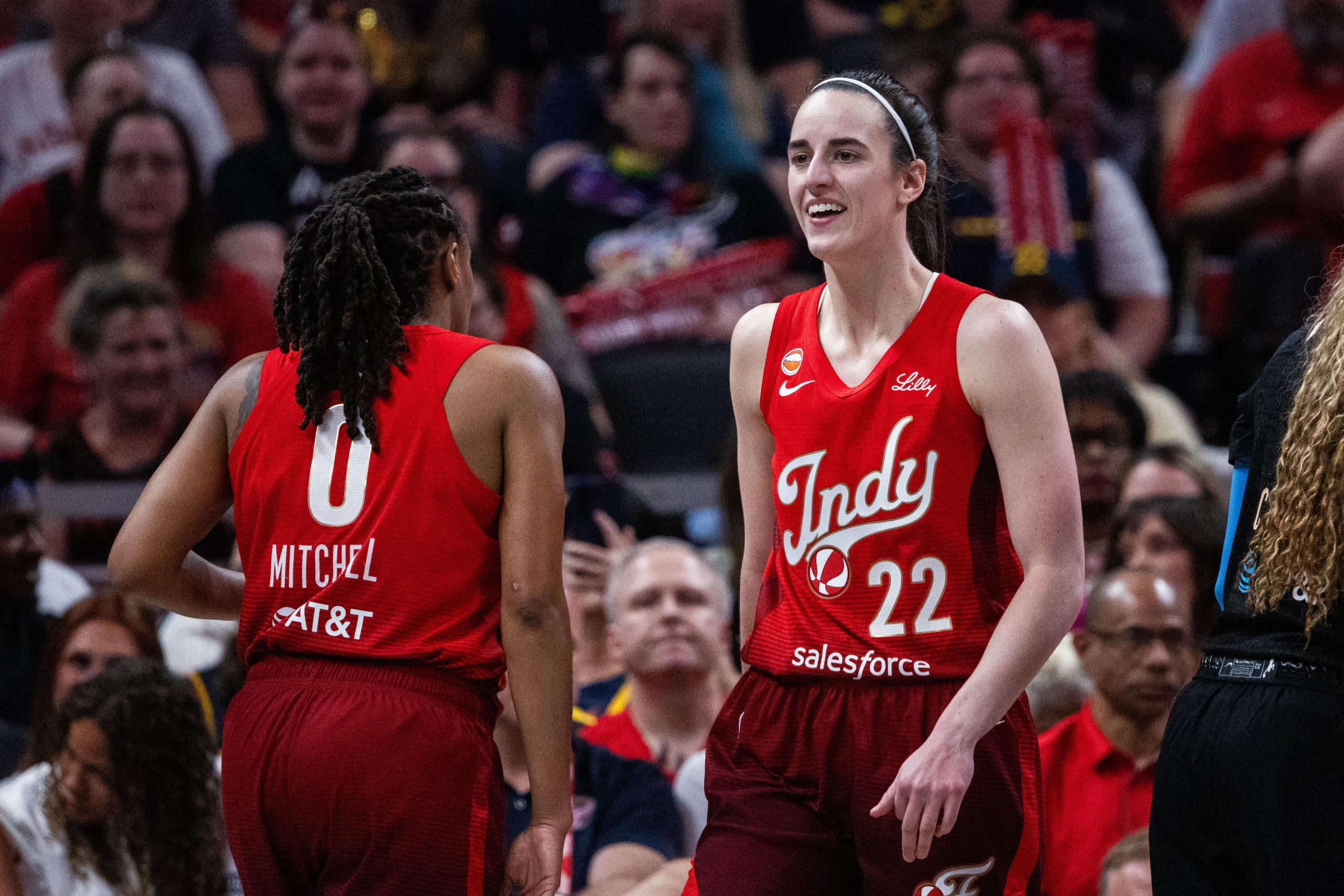
Mitchell's importance provides perhaps the clearest example.
She has spent years building her career in Indiana.
Long before the Fever became one of basketball's biggest attractions, Mitchell was producing points through difficult seasons and limited national attention.
She has been one of the franchise's most reliable offensive weapons.
That history matters.
For longtime Fever supporters, Mitchell represents continuity.
She knows what Indiana looked like before sold-out buildings and constant national television exposure.
She understands the years when victories were harder to find and the spotlight was much smaller.
Clark's arrival changed the scale of everything surrounding the franchise.
It did not erase the players who were already there.
That may be the simplest explanation for White's gesture.
Coaches constantly search for ways to make players feel recognized.
Sometimes that means public praise.
Sometimes it means a private conversation.
Sometimes it means designing an offensive possession specifically for someone.
And sometimes it can be as uncomplicated as wearing a shirt.
But social media rarely rewards uncomplicated explanations.

Almost immediately, fans began interpreting the gesture through the lens of team hierarchy.
Was White signaling that Mitchell deserved more attention?
Was she pushing back against the idea that everything about Indiana begins and ends with Clark?
Was there a hidden message?
Those are intriguing questions.
They are also questions that require evidence before being transformed into conclusions.
A shirt alone does not establish locker-room tension.
It does not prove a disagreement between Clark and Mitchell.
It does not prove White is choosing one player over another.
And it certainly does not demonstrate a fractured team.
That distinction becomes important whenever ordinary team interactions become viral content.
Modern sports fandom has increasingly turned body language into a form of amateur investigation.
A player does not celebrate enthusiastically enough?
Conflict.
A coach sits beside one player rather than another?
Conflict.
Two teammates do not immediately make eye contact after a possession?
Conflict.
A coach wears one player's shirt?
Suddenly, there must be a hierarchy battle.
Sometimes those interpretations eventually prove meaningful.
Often they do not.
Basketball teams contain dozens of relationships operating simultaneously.
A coach can praise Mitchell without criticizing Clark.
Clark can receive enormous attention without diminishing Mitchell's value.
Mitchell can embrace a leadership role without demanding that Indiana revolve around her.
Multiple things can be true at once.
In fact, Indiana's success may depend on precisely that balance.
Clark's passing and shooting gravity can fundamentally reshape defenses.
Mitchell's scoring ability can punish those defenses when they overcommit.
When the two operate together effectively, opponents face an uncomfortable choice.
Load additional pressure toward Clark and risk giving Mitchell opportunities.
Stay attached to Mitchell and potentially allow Clark more freedom.
Add Aliyah Boston to the equation and the decision-making becomes even more complicated.
That is not necessarily a hierarchy problem.
It can be a basketball advantage.
White's responsibility is to make those pieces work together.
That requires more than drawing plays.
It requires managing personalities.
Confidence.
Roles.
Recognition.
Pressure.
Media attention.
Every coach of a star-heavy team faces some version of that challenge.
But Indiana's situation is unusually intense because Clark's celebrity extends far beyond ordinary basketball coverage.
A coach therefore has to maintain two realities simultaneously.
Acknowledge the obvious importance of the franchise's most visible player.
And ensure everyone else understands that their contribution still matters.
Mitchell is particularly important in that equation.
She is not simply another role player waiting for opportunities created by Clark.
She is an established scorer capable of carrying stretches of offense herself.
That matters enormously in playoff basketball.
Defenses eventually find ways to make superstars uncomfortable.
When Clark is trapped, denied or forced away from preferred actions, Indiana needs someone capable of attacking the opening.
Mitchell can be that player.
Recognition of her importance therefore does not have to represent a challenge to Clark.
It can represent an understanding of what Indiana needs to win.
That is why the most revealing detail in the entire controversy may be what did not happen.
There was no need for a dramatic organizational declaration turning the shirt into a major internal issue.
Sometimes the absence of an extraordinary response is itself instructive.
Teams generally understand that social-media narratives can expand far beyond the significance of the original moment.
Responding aggressively can accidentally legitimize speculation.
Explaining every minor gesture can create another headline.
The smarter approach can be to continue operating normally.
Players practice.
Coaches coach.
Games continue.
The shirt remains a shirt unless evidence establishes something more.
That will not stop the debate.
The Fever are too visible.
Clark is too famous.
Mitchell is too important.
White occupies too central a position.
Every interaction between them will continue generating interpretations.
But there is another possibility worth considering.
Perhaps White wanted Mitchell to feel appreciated.
Perhaps she wanted fans to appreciate her too.
If so, the gesture would fit one of the fundamental responsibilities of coaching.
Make sure important players understand that they are seen.
That matters especially for veterans who spent years helping build a franchise before national attention arrived.
There is also something healthy about a team publicly celebrating multiple players.
Sports marketing naturally gravitates toward superstars.
The biggest name receives the commercial.
The headline.
The television promo.
The jersey sales.
But teams do not win because one player dominates the marketing campaign.
They win because multiple players perform their roles.
A coach highlighting Mitchell can therefore be interpreted as an attempt to widen the spotlight rather than redirect it.
That interpretation is less dramatic.
It may also be more reasonable.
Of course, basketball will eventually provide the most meaningful evidence.
Watch the rotations.
Watch who handles the ball late.
Watch how Clark and Mitchell communicate.
Watch how White structures the offense.
Watch how players react when teammates succeed.
Those details reveal far more about team dynamics than one piece of clothing.
If genuine tension exists, it will eventually appear through basketball decisions, credible reporting or direct statements.
Until then, declaring a locker-room fracture based on a shirt risks turning speculation into supposed fact.
What the controversy unquestionably demonstrates is the scale of attention surrounding Indiana.
A few seasons ago, a coach's wardrobe might have attracted little notice outside dedicated Fever supporters.
Now it can become a national WNBA discussion.
That is the Clark effect.
But ironically, this particular debate also demonstrates why Indiana cannot become exclusively the Clark show.
The Fever have other stories.
Other personalities.
Other stars.
Mitchell is one of them.
Perhaps White's shirt did contain a message after all.
Not a secret warning.
Not a declaration of hierarchy.
Something much simpler.
Kelsey Mitchell matters.
And if Indiana wants to go where it believes it can go, she will matter enormously.
Whether social media accepts such a straightforward explanation is another question entirely.
A simple shirt choice from Indiana Fever head coach Stephanie White just set off a massive firestorm across the WNBA.
When White stepped out wearing a shirt loudly celebrating teammate Kelsey Mitchell, fans immediately took notice.
What began as a seemingly harmless show of locker room support spiraled into an intense debate about team hierarchy and hidden messages.
As social media blew up, the Fever organization was pulled straight into the storm, forced to handle a rapidly growing PR headache.
Yet, one subtle detail behind the team's official response is making fans completely re-evaluate what actually happened on that sideline.
Was this just a innocent gesture of veteran support, or is there a much deeper tension brewing inside the Indiana Fever locker room?
- Read full in comment 👇👇👇